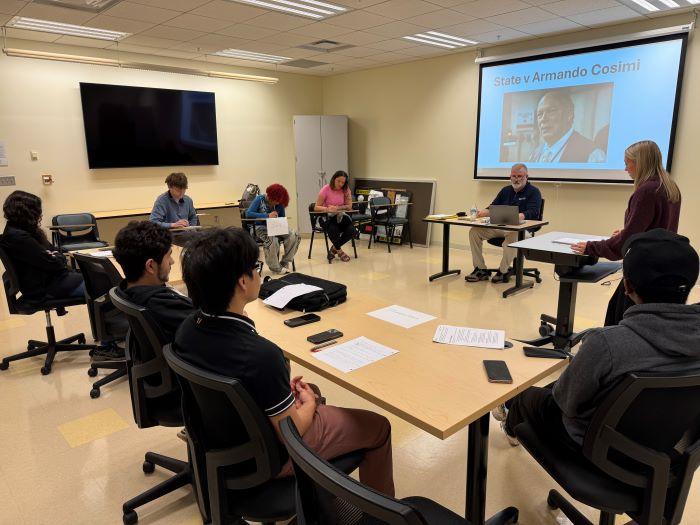
"Good morning ladies and gentlemen of the jury. My name is Peyton George. I'm part of the prosecution team for the case of State versus Armando Cosimi."
And with that, the final exam is underway in Professor Pete Patnode's Criminal Investigations (CRJ-142) class. The Ferrante Hall classroom turned courtroom includes Professor Patnode playing the role of judge, George and her team representing the people, a team of students presenting the case on behalf of the defense, and a team of students playing the role of jurors.
It’s all part of an immersive final exam designed by Patnode, a 20-year veteran of the Syracuse Police Department, who is always looking for new ways to measure what students truly understand.
For the final exam, he divided the class into four groups, rotating them through each role in the legal process. Each team was assigned a real homicide case from outside New York State and tasked with reconstructing it from the ground up. “They had to investigate the witnesses and evidence, decide what mattered most, and determine how to present it,” Patnode said. “Then the prosecution makes its case, the defense responds, and the jury delivers a verdict.”
The project unfolded across 13 graded steps, culminating in the trial and followed by individual post-trial reports. For Patnode, the approach goes far beyond a traditional test. “I could give a 100-question exam,” he said, “but it wouldn’t measure learning the way this does. To bring a case to trial, you have to do the right things.”
Students "plead guilty" to enjoying this final exam experience. “I liked this more than a typical exam,” said George. “We got to engage with each other and work through real-world scenarios.”
Classmate Isabella Brightman agreed, pointing to Patnode’s firsthand experience as a key part of the course’s impact. “He’s actually been in court before, so it was great to learn from him and then apply it ourselves,” she said. “This felt real. We learned how important it is to have your evidence organized, and how much the way you present it matters.”
In this classroom-turned-courtroom, the final exam was all about thinking critically, communicating clearly, and experiencing the justice system from every angle.